ACTREG North America
North American sales and service
20675 Boul. IndustrielH9X 4B2 Sainte-Anne-de-Bellevue, Canada
PNEUMATIC · HYDRAULIC · QUARTER-TURN
ACTREG builds the pneumatic and hydraulic actuators that drive ball, butterfly and plug valves. Two opposed pistons, one pinion, ninety degrees — and the torque has to be there at the seat, where the valve demands most of it.
Drag the body, or the scale, and watch the opposed racks turn the pinion. Double-acting torque is constant because the lever arm never changes.
Output torque
3 956Nm
2 918 lbf·ft at 6 bar
Across the quarter turn
Thrust spent compressing the springs is thrust the valve never sees, so air-stroke torque falls as travel grows.
Butterfly disc
Closed0° of 90°
Four mechanisms cover the whole span, and they overlap on purpose. Where two ranges meet, the choice is made on torque curve, weight and failure mode rather than on capacity alone.
ADA / ASR — 5 to 6 500 Nm
SY01 — 293 to 258 616 Nm
SY01 — 172 to 71 046 Nm
SY02 — 315 to 250 000 Nm
Output torque in Nm, logarithmic
Rack and pinion for compact, constant-torque duty; scotch yoke when the valve needs its torque at the seat and the figures run into six digits. Hydraulic and electric drives sit on the same valve interface.
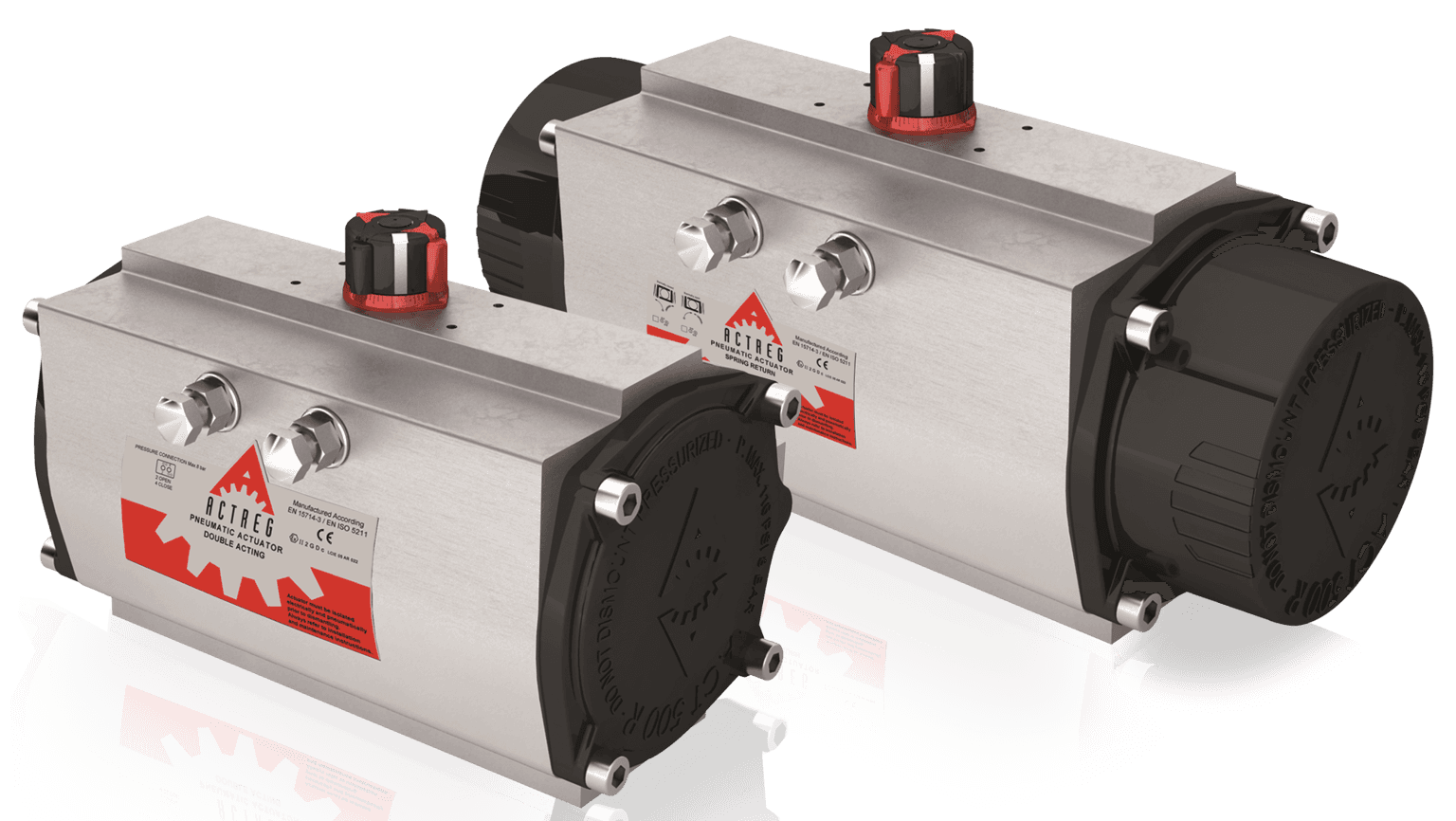
ADA / ASR
5 – 6 500 Nm
A compact pneumatic actuator for quarter-turn valves up to 6,500 Nm, built on an anodised aluminium body with two opposed pistons driving a central pinion. Because the lever arm never changes, double-acting torque is constant across the full 90°.
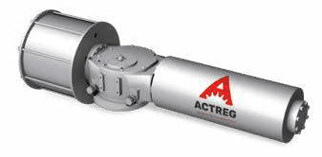
SY01 / SY02 / SY01K
293 – 258 616 Nm
A heavy-duty quarter-turn actuator available in ten sizes from F10 to F60 across fourteen body variants, reaching 258,616 Nm pneumatically and 250,000 Nm hydraulically. The scotch yoke geometry delivers its peak torque at the seat, matching the point where a ball or butterfly valve demands most.
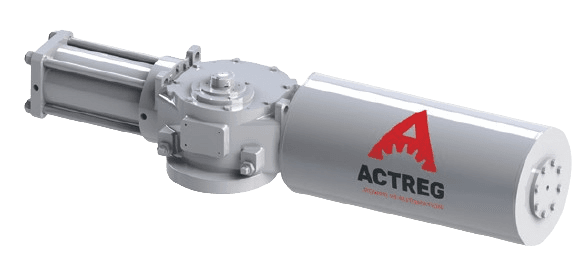
SY02
315 – 250 000 Nm
Hydraulic quarter-turn actuators in double-acting and spring-return configurations, for duty where the available air supply cannot produce the required torque or where stroke speed must be closely controlled.
Quoted per project
Electric quarter-turn actuators for sites with no compressed air or hydraulic ring main, specified alongside the pneumatic range so a single plant can standardise on one valve interface.
Everything else about a rack and pinion body stays the same across the four constructions below. Choosing one is a question of how cold the site gets in winter and how hot the line runs in service.
Standard construction
High temperature
Low temperature
Very low temperature
Ambient and process temperature in °C
Anything that turns through a quarter of a circle is in scope.
Assembly and engineering sit in Gavá, outside Barcelona. Shanghai manufactures for Asia-Pacific, and stock in Kettering, Québec and Sorocaba keeps lead times short in each region.
ACTREG North America
North American sales and service
20675 Boul. IndustrielACTREG do Brasil
South American sales and assembly
Avenida Liberdade 4565, Bairro IporangaACTREG UK Ltd
United Kingdom sales and stock
Units 2 & 3 Henson Close, Telford Way Industrial EstateACTREG S.A.U.
Headquarters, engineering and assembly
Carrer de l'Energia 15-25, naves 1-2, Pol. Ind. BarnasudACTREG Shanghai Actuator Co. Ltd
Asia-Pacific manufacturing and sales
No. 125 Ji Ye Road, SheShan Industrial Zone, Songjiang DistrictNorth American sales and service
20675 Boul. IndustrielSouth American sales and assembly
Avenida Liberdade 4565, Bairro IporangaUnited Kingdom sales and stock
Units 2 & 3 Henson Close, Telford Way Industrial EstateHeadquarters, engineering and assembly
Carrer de l'Energia 15-25, naves 1-2, Pol. Ind. BarnasudAsia-Pacific manufacturing and sales
No. 125 Ji Ye Road, SheShan Industrial Zone, Songjiang DistrictIf the answer you need is not here, the engineering team in Gavá will size an actuator against your valve torque figures.
A rack and pinion actuator produces constant torque across the full quarter turn, while a scotch yoke produces its highest torque at the ends of travel. Rack and pinion suits valves with an even torque demand up to about 6,500 Nm; scotch yoke suits large ball and butterfly valves whose demand peaks at the seat, and reaches 250,000 Nm.
The range covers 5 Nm to 250,000 Nm. Rack and pinion units span 5 to 6,500 Nm across sizes 10 to 4000, with the largest producing 6,421 Nm at 8 bar. Scotch yoke units run from 293 Nm to 258,616 Nm pneumatically and from 315 Nm to 250,000 Nm hydraulically.
On the air stroke a spring-return actuator spends part of its piston thrust compressing the springs, so the torque reaching the valve falls as travel increases. A size 4000 with the S08 spring set delivers 3,956 Nm at 0° and 3,288 Nm at 90° on a 6 bar supply. On the spring stroke the opposite happens: torque is highest the moment air is lost and lowest at the seat, which is why the spring end torque is the figure that must cover valve demand.
Valve connections follow ISO 5211 with a DIN 3337 octagonal drive. Solenoid valves mount directly to the NAMUR interface with no external tubing, and switchboxes or positioners mount on the VDI/VDE 3845 accessory bracket.
Standard NBR construction on the rack and pinion range covers −30 °C to +100 °C. FKM O-rings extend the upper limit to +150 °C, silicone O-rings take the lower limit to −40 °C, and silicone O-rings with a 316 stainless pinion reach −55 °C. Scotch yoke constructions are published separately: standard −20 °C to +80 °C, low temperature −40 °C to +80 °C, high temperature −20 °C to +120 °C, and extreme low temperature down to −60 °C.
Yes. Rack and pinion units adjust ±5° between 85° and 95° using screws in the body, in both directions of travel, and the screws are sized to absorb full rated torque plus the shock load of the stop. Scotch yoke units adjust between 80° and 100° on external travel stops.
Yes. The rack and pinion spring cartridges are designed so springs can be replaced without releasing stored energy into the assembly, which removes the main hazard in spring-return maintenance.
Yes. A spring-return unit fails to its safe position when supply pressure is lost. On the scotch yoke range a single-acting spring cylinder mounts to either side of the modular centre body, so a double-acting actuator can be converted to emergency shutdown duty without changing the valve interface.
Quotations come back with the torque calculation, the spring set and the construction we would specify, so the figures can be checked against your own.